01 — In 30 seconds
The problemMood apps log feelings and stop there, so people forget them.
What I didResearch, personas, information architecture, UI and a full prototype during my master’s at Elisava.
The key decisionClose the loop: check in, get an activity for that mood, see if it helped.
The resultZama Health acquired the concept, I led its 0-to-1 product for college athletes, and Zama was later acquired by Volt Athletics for $380K.
02 The problem
25%rise in anxiety and depression worldwide in the first year of COVID-19 (WHO, 2022).
Passive apps get forgottenExisting trackers give no reason to come back every day.
Free time goes to wastePeople don’t know what they could do in the city when they finally have an hour.
03 Research
Three trends shaped the brief: digital and virtual care, data to understand the patient, and a shift to self-care and prevention. People told us they want to spot their emotional triggers before things get worse.
Persona · Vicente, 37The workaholicRemote developer who has put his physical and mental health aside. Wants to understand what triggers his emotions and find something he can stick to.
Persona · Emilia, 28FOMOJournalist with an unpredictable schedule. Wants to see friends and never miss a plan, but the apps she tried were too passive and she forgot them.
04 The hardest call
Should Sphere record feelings, or act on them?
A · A better journalLog moods beautifully. The same trap as the apps Emilia abandoned.
B · An activity finderSuggest plans, skip the check-in. Loses the self-awareness Vicente needs.
C · Chosen: the loopCheck in → activity for that mood → insights over the week.
05 Solution
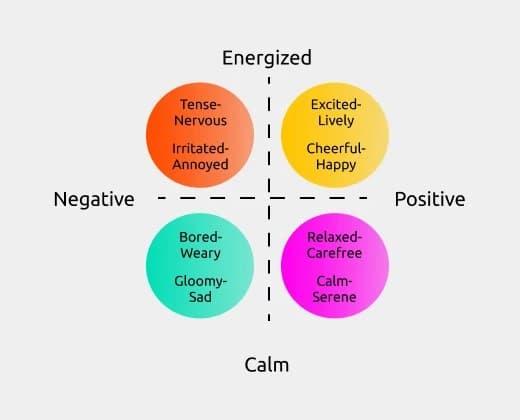
A check-in, not a diaryPick how you feel on a map of energy and mood instead of writing about it. One tap tells Sphere enough to help.
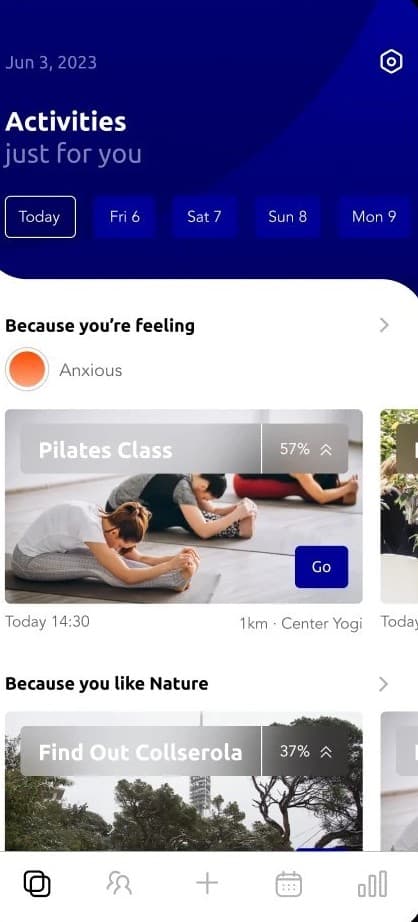
“Because you’re feeling anxious”Activities nearby, matched to your mood, your likes and even the weather. Book it, share it with a friend, go.
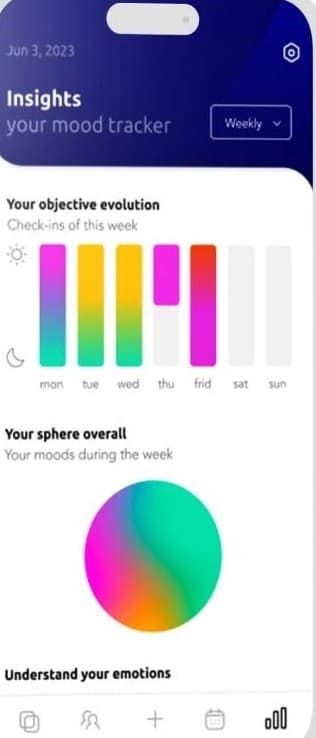
Your week as a sphereInsights show whether your mood is improving, and Sphere flags alarming patterns gently, before they become a crisis.
06 Emotions as a system
Colour carries meaning here. I mapped the Emotion Identification Model (Watson and Tellegen, 1985) to four colours, one per quadrant, and kept a single deep blue for the interface so emotions always stand out.
Interface
#000099
Positive · energized
#FFC500
Positive · calm
#F32CE6
Negative · energized
#FF4B00
Negative · calm
#00DEB5
Type: Ubuntu for headings, rounded enough to feel close; Avenir for long text. Voice: kind, caring and close; scientific but easy to understand.
07 From master’s project to a real product
Zama Health, a sports psychology and mental wellness platform for college athletes, wanted to replicate Sphere’s whole flow, above all the mechanism for capturing emotions, with activity recommendations people could do on a university campus. I led the 0-to-1 product design.
Product & UXEnd-to-end experience, interface and information architecture, turning the concept into a B2B SaaS with digital modules and a clinical network.
EngagementA daily mood tracker, habit loops and personalised recommendations for on-campus activities, built for daily use.
SocialPush notifications and peer-to-peer connections, so athletes could link up with friends for activities together.
$380KZama Health was acquired by Volt Athletics. The product design and the retention mechanics behind its traction were part of that story.
08 What I learned
Design for sensitive contextsEmpathy and clarity matter more than features when the topic is your mental health.
Turn insight into actionResearch is only useful when it changes what the product does, not just what it says.